In Defense of Cinema — An Initiation
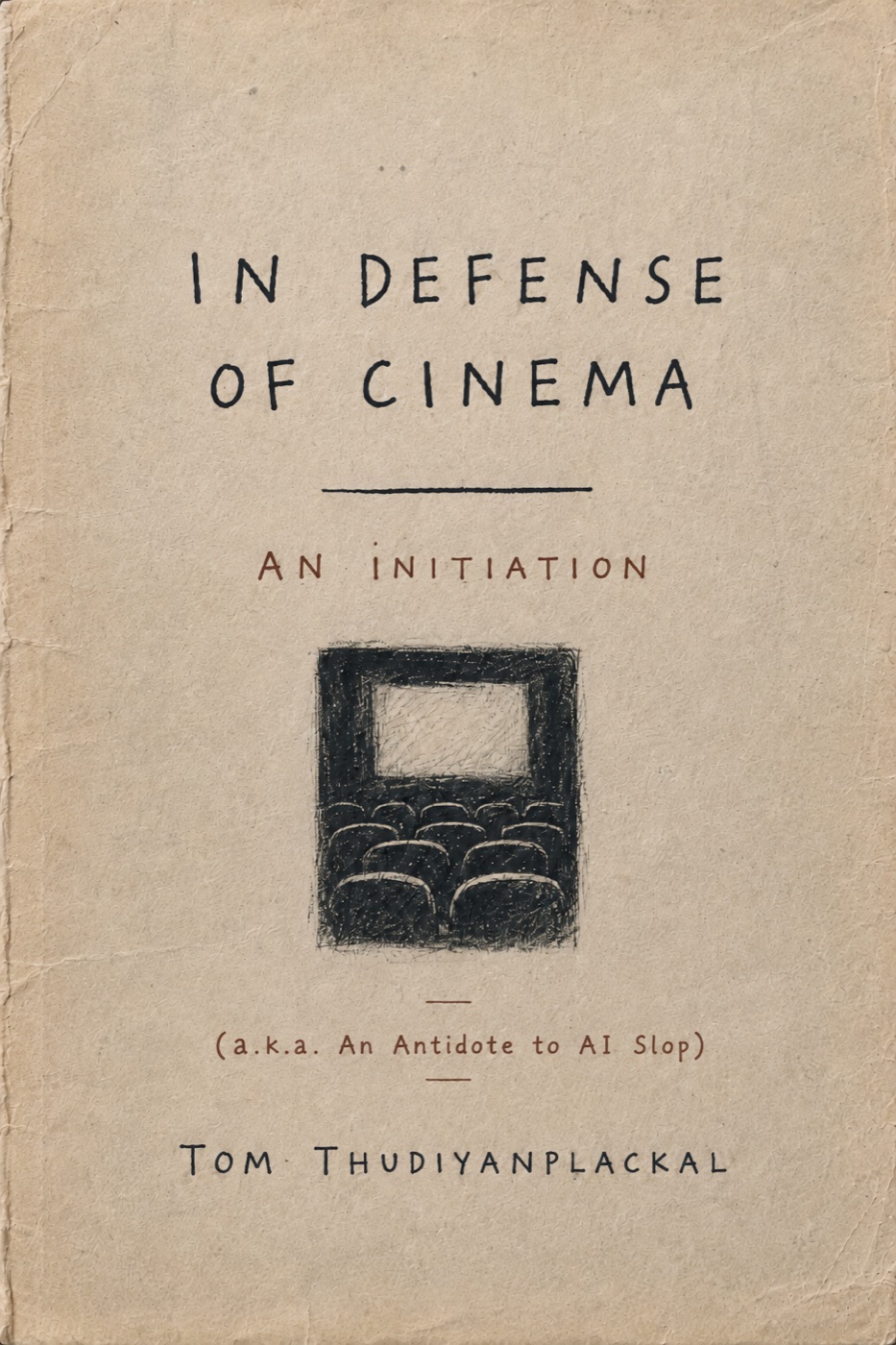
Cover of In Defense of Cinema: An Initiation by Tom Thudiyanplackal — a hand-inked drawing of a cinema screen and rows of empty seats on aged kraft paper.

A Manifesto · A War Cry

In Defense
of Cinema

An Initiation

a.k.a. An Antidote to AI Slop

A prophetic, uncompromising book about what cinema is, what it has been capable of at its highest, and what is now being done to it by the apparatus that captured it.

Just over 100,000 words · 35 chapters · unabridged audiobook, 11 hours 11 minutes

Scroll

From the author

An Invitation

A two-minute invitation, digitally delivered.

What the book is

Not a study. A defense.

Cinema, in the strict sense this book reclaims, is not the broad category of moving-image entertainment. It is an art form arrived at only through the thorough distillation of ideas down to their essences — a discipline of vision pursued the way intellectuals once pursued scientific inquiry, metaphysical discourse, and prophecy. Though every work deserving the title is also a movie, not every movie should be confused for cinema.

Across five parts, the book establishes what cinema is, traces the lineage it inherits, holds up the witnesses who carried the form across its first century, diagnoses what has been done to it across its second — the captured world, the weaponized mind, the cookie cutter, the three deceits — and names what is now required of the practitioner and the audience who would defend it.

The voice is not the voice of a scholar conducting a balanced examination. It is the voice of someone who has been changed by the encounters the book defends, written in a register the author describes plainly: a sermon delivered at a funeral by someone who actually loved the dead. It is dense by design, repetitive by design, and unapologetic about both.
You cannot defend what you cannot define. You cannot define what you are unwilling to distinguish from everything that resembles it.
— from “Cinema Defined — The Standard”

The structure

Five parts, one charge

Part Zero & One — The Diagnosis & The Definition

What cinema is, and what is being lost

From the collapse already underway and the artist's betrayal, to the precise Standard by which cinema is distinguished from everything that wears its clothes.

  • Before the Collapse
  • The Artist's Betrayal
  • Why Cinema Specifically
  • Cinema Defined — The Standard
  • The Auteur as Initiate
Part Two — The Industry

Art, commerce, science, Hollywood

How the business model — converting attention into dollars — produced the cookie cutter, the colonized mind, and the three deceits the medium now lives inside.

  • Art, Commerce & Science
  • The Cookie Cutter
  • The Three Deceits
  • Hollywood and the New Guard
Part Three — The Witnesses

Those who carried the form

Thirteen practitioners whose work demonstrates what cinema at its highest has been capable of — examined not as a canon but as evidence.

  • Tarkovsky
  • Bergman
  • Kubrick
  • Fellini
  • Kiarostami
  • Ray
  • Kieślowski
  • Campion
  • Iñárritu
  • Coppola
  • Arnold
  • Von Trier
  • Moodysson
Part Four — The Threat

The age of AI and the captured world

The diagnosis at full force: the arrival of AI as the most comprehensive instrument yet for replacing the tradition with simulations that contain none of its substance, and the Silicon Valley apparatus that weaponized the mind.

  • The Age of AI
  • The Captured World
  • The Weaponized Mind
Part Five — The Charge

The unreturnable journey

What remains, what the lineage continues to make available, and what is required now of the practitioner and the audience willing to receive it.

  • The Unreturnable Journey

Part Three

The Witnesses

The chapters that hold up, one practitioner at a time, the demonstration of what the form has done — “the door long unused,” “the face as territory,” “the architecture of inevitability.”

TarkovskyThe Door Long Unused
BergmanThe Face as Territory
KubrickThe Architecture of Inevitability
FelliniThe Set as the Inside of His Mind
KiarostamiCinema as Question
RayCinema as Witnessing
KieślowskiCinema as Moral Weather
CampionThe Piano, the Single Summit
IñárrituThe One-Summit Wonder
CoppolaThe Singular Summit
Andrea ArnoldFish Tank
Von TrierThe Provocation
MoodyssonCinema as Unbearable Love

From the preface

The Difference Between Seeing and Watching

I was five years old. The theater was named the Regal. The country was India. The household I had been born into was Catholic, in a primarily Hindu nation, which made us a minority. I had not seen much about Christ's teachings in practice in the society around me.

Then I walked into that theater. The film was Ben Hur. The lights went down. The screen began to throw light into the dark space where I was sitting. And what unfolded was a portal. I had traveled two thousand years in time. I had entered the life of an adult human who bore such sacrifices, an ego that was built up and torn down, all that could be won was had and lost entirely, for the loss to feel complete. I had never earned anything to know what that felt like. But there, in that darkened hall, I knew.

Those things I knew remained with me. That knowledge did not belong to a five-year-old. But it was known to me regardless. I could not articulate what I had learned, what I had felt, what I had been in communion with. But it was inseparable from my spirit from that moment forward.

— Opening of the book

Or hear the opening, in the author's digital voice:

It is a way I am processing my grief, turning it into a manifesto, and sending it into the world as a war cry for those who care to rise up in arms.
— Tom Thudiyanplackal
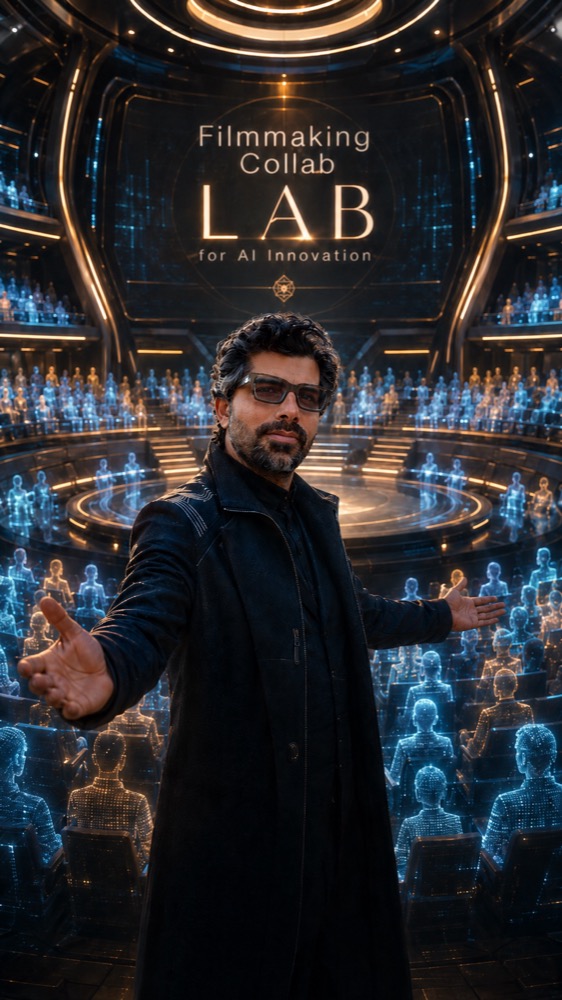
Tom Thudiyanplackal, filmmaker and author of In Defense of Cinema. Tom Thudiyanplackal

About the author

Forty years in service of the medium

Tom Thudiyanplackal is a filmmaker, futurist, production technologist, and entrepreneur whose career has crossed advertising at Ogilvy, India's fastest-growing mobile network at Reliance, film school in Prague, and development on blockbusters at Vinod Chopra Films — to executive-producing at USC's Entertainment Technology Center and founding The Storyteller's Desk.

He writes not as a critic but as a practitioner in adjacent fields who has watched the medium he loves progressively dismantled — and decided to defend it.

The Workshop · Coming soon

Read the book. Prepare for the Workshop.

The book hands you the Standard. The Workshop is where you take it up — Storytelling in the Age of AI, an eight-session initiation built on the book. We bring it to you online, and we come in person to the cities where the pull is strongest. The list decides where we land first.

The flagship · Storytelling in the Age of AI

The Workshop

Not a craft bootcamp — the beginning of a lifelong practice. Eight sessions that hand over the Standard, train the faculties the new tools tempt you to outsource, and teach you to work with those tools without surrendering what makes the work yours.

  • Eight sessions
  • Online, live
  • In person, city by city
  • The Standard as daily practice

Coming soon — enrollment opens to the list first

Also with Tom

Speaking, the tour & studio work

Booking interest

Speaking & the tour

Keynotes, seminars, and working sessions on cinema, storytelling, and the production technology reshaping both — and the in-person Workshop tour, routed to the cities that raise their hands.

For studios & investors

Consulting & troubleshooting

Studio consulting, hands-on production troubleshooting, talent hunts, material prospecting, and IP development — the book's Standard applied to what gets made and what deserves backing.

Get the book

Read it, or hear it

A digitally narrated audiobook and an ebook, with a limited-edition print run to follow. Buy direct, or find it wherever you already read and listen — including in the car.

Audiobook · digitally narrated

Listen — even while driving

Full unabridged narration — 11 hours 11 minutes across 35 chapters. Buy direct as a single chaptered audiobook file that plays in Apple Books and any audiobook app, or find it on the listening service you already use.

Recommended — buy direct

Narrated by a digital voice created from the author's own. Libro.fm sends a share of every sale to an independent bookstore of your choosing · more listening platforms arriving as distribution completes.

Limited edition · print

A limited print run — coming

A small, hand-finished print edition for those who want the object on the shelf. Join the list to be told the moment it opens.

Every format is the same book. Buying direct costs you exactly the same — it simply puts far more of it back into the author's hands, and into the next volume.

Join the movement

Enroll your city. Prepare for the Workshop.

The list is where the Workshop opens first — and where you tell us which city to bring it to in person. Read the book, then get ready.